Companies and institutions are increasingly looking for smarter and more efficient ways to manage their attendance systems. One such solution that has been gaining immense popularity is the GPS-Based Attendance System. This advanced technology combines the benefits of Global Positioning System (GPS) tracking with traditional attendance monitoring methods to offer a more accurate, reliable, and transparent way of recording attendance. Whether you are managing employees in a corporate office, tracking student attendance in schools, or monitoring field staff, a GPS-Based Attendance System can transform the way attendance is tracked and managed.
A GPS-Based Attendance System is an innovative solution that uses GPS technology to track the geographical location of individuals at the time of clocking in or out. Instead of relying solely on manual entry or fingerprint-based biometric systems, this technology allows employees, students, or workers to check in or out from specific locations, certifying that attendance is marked only when they are physically present at the required location. The system uses the GPS coordinates of the device, whether it is a smartphone or a dedicated GPS device, to verify the location of the individual in real-time.
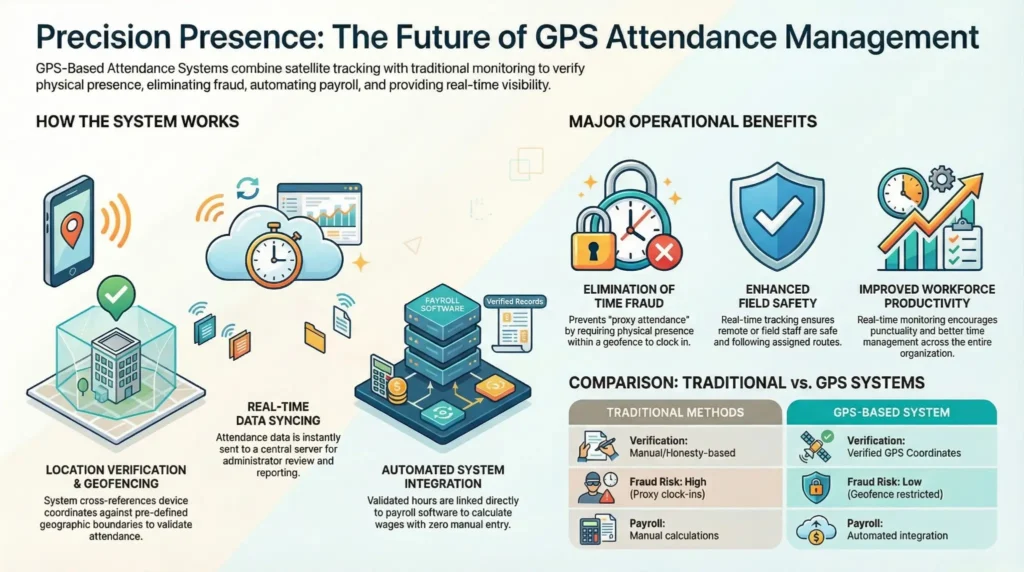
One of the most significant advantages of the GPS-Based Attendance System is the accuracy it offers. Unlike traditional attendance methods, such as paper-based registers or punch cards, this system confirms that the attendance data is accurately recorded based on the individual’s location. This eliminates issues related to proxy attendance or incorrect reporting.
With a GPS-enabled system, managers and administrators can track the exact location of an individual in real time. This means that you can instantly verify whether an employee has arrived at work or whether a student has arrived at school. Real-time monitoring enhances accountability and helps in making informed decisions, particularly for companies or organizations with multiple locations or mobile workers.
Time fraud is often a concern, as employees or students can mark attendance without physically being present at the location. However, with a GPS-Based Attendance System, this issue is eliminated. The GPS system only allows attendance to be marked when the person is physically at the designated location, reducing the chances of fraud or manipulation.
The GPS-Based Attendance System not only helps in recording attendance but also streamlines payroll processing. By linking attendance data with payroll software, employers can automatically calculate wages based on the actual hours worked. This saves time and reduces errors in manual payroll calculations, confirming that employees are paid accurately for the time they have worked.
The introduction of GPS technology into the attendance system encourages employees to be more punctual and disciplined. Knowing that attendance is being monitored in real time, employees are more likely to adhere to their work schedules. This results in better time management and improved productivity across the organization.
For businesses that deal with field staff, delivery personnel, or remote workers, a GPS-Based Attendance System adds an extra layer of security. Employers can track the location of their workers, confirming that they are not in dangerous areas or deviating from their work routes. Additionally, in case of any emergencies, the system can provide the exact location of employees, certifying that help can be dispatched promptly.
The GPS-Based Attendance System works through a combination of GPS-enabled devices and software. Here’s how the system typically functions:
Employees or students are issued a device, which could be a smartphone with a GPS-enabled app or a dedicated GPS tracking device. The device is configured to interact with the GPS-based system, confirming that the person’s location is tracked during check-in and check-out.
When the person checks in or checks out of work or school, the system captures their exact GPS coordinates. The system cross-references the GPS data with pre-defined geofences or boundaries, certifying that the individual is within the permitted location for attendance to be valid.
The GPS data is synced with the central server, where attendance records are stored. This information is accessible to managers and administrators for review, reporting, and payroll processing.
The system generates detailed reports based on attendance data, location tracking, and time stamps. Managers can review these reports to ensure that attendance policies are being followed and that employees are working in the correct locations.
Corporate Offices: In a corporate setting, the GPS-Based Attendance System helps employers track the punctuality and location of employees. It is particularly useful for companies with mobile workers, such as field agents or remote teams, who need to clock in from specific locations.
Schools and Universities: Educational institutions can implement a GPS-based attendance system to track student attendance and ensure they are present at the school campus. This system can also be integrated with school buses to monitor the attendance of students as they arrive at school.
Field Staff and Delivery Services: For businesses that have delivery services, such as logistics companies, a GPS-Based Attendance System confirms that drivers are not only present at the right location but also follow the correct route. This minimizes delays, improves accountability, and helps track delivery progress.
Healthcare Sector: In healthcare, especially for home healthcare workers, a GPS-Based Attendance System is an excellent way to monitor the arrival and departure of medical professionals visiting patients at their homes. It confirms that healthcare workers are on time and following their schedules accurately.
When choosing a GPS-Based Attendance System, it is essential to ensure that the system offers the following features:
This allows you to define specific geographic boundaries where attendance can be marked, certifying that individuals are only allowed to check in or out when within the designated area.
Receive notifications if an employee or student fails to check in or out at the designated location or if they try to mark attendance outside of the specified geofenced area.
The system should have an intuitive interface that is easy for both employees and administrators to use. This confirms smooth adoption of the system without the need for extensive training.
Look for a system that integrates with other software, such as payroll, HR management systems, and time tracking systems. This will help streamline processes and reduce manual data entry.
A good GPS-Based Attendance System should work seamlessly with smartphones or tablets. This allows for flexibility, as employees can clock in and out from any location.
The GPS-Based Attendance System is a game-changer for organizations looking to streamline their attendance tracking process, reduce time fraud, and improve productivity. By combining the power of GPS technology with attendance monitoring, this system provides an accurate, real-time solution for businesses, schools, and organizations of all sizes. With its numerous benefits, such as improved accuracy, reduced fraud, enhanced productivity, and easier payroll processing, adopting a GPS-Based Attendance System can undoubtedly enhance your attendance management practices and improve overall operational efficiency. If you are looking for a way to make attendance management simpler, more accurate, and more transparent, investing in a GPS-Based Attendance System is the way forward.

We empower businesses across Pakistan with secure, efficient, and regulation-ready billing solutions, making tax compliance simpler, faster, and smarter.
© 2025 Tax Jar. All Rights Reserved
WhatsApp us